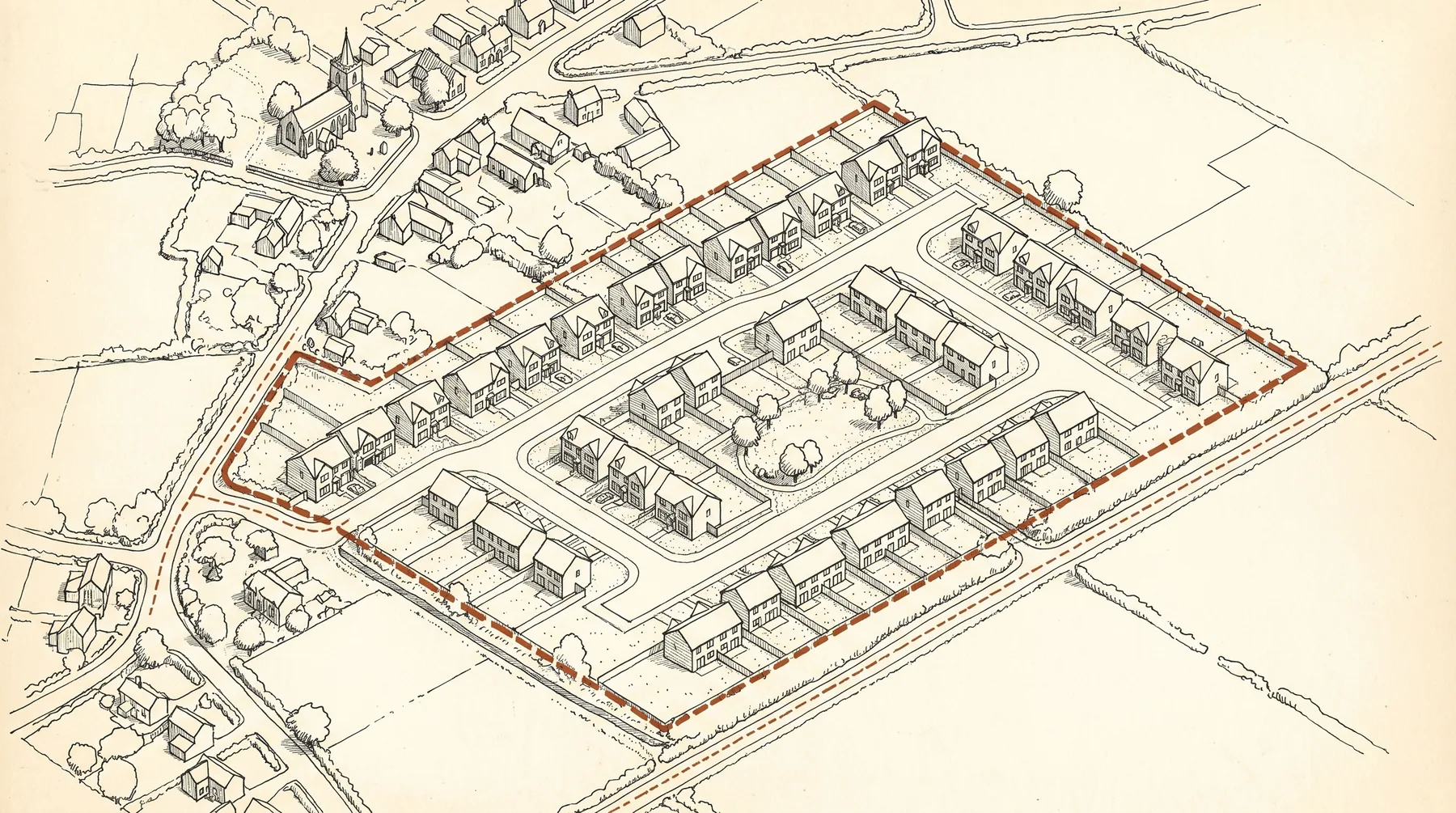
In 2020, the Place Alliance at UCL audited 142 major housing schemes built across England. Seventy-five per cent were rated mediocre or poor. One in five was so bad it should never have received planning permission. In rural areas, the figure was worse: 94% of audited rural schemes failed to meet the design standards that should have ensured approval (Place Alliance/UCL, A Housing Design Audit for England, 2020; CPRE breakdown).
The same researchers found something else. The same volume housebuilders who produced the worst-scoring schemes also produced some of the best. Professor Matthew Carmona, who led the audit, put it simply: "If they are pushed, they can do it." The question is why nobody pushes them.
The product.
Volume housebuilders operate a standardised product range. Each company maintains a catalogue of named house types, designed centrally, built repeatedly across hundreds of sites. The footprint, the room layout, the staircase position, and the window schedule are fixed. The elevations vary: stone effect in the Cotswolds, brick in the Midlands, render in the South West. The house underneath is the same. Carmona documented the same house type appearing identically in Bridgewater, Norwich, and Truro.
When a builder acquires a site, it commissions architects or consultants to produce a site-specific layout. Every site has different constraints: access, topography, drainage, ecology, boundary conditions. A bespoke design is produced. The process is reverse-engineered from the house types. The question the architect is answering is how many standard units fit onto this site given the constraints. The brief is yield.
This is the business model. Sir Oliver Letwin's government-commissioned Independent Review of Build Out (2018) identified it directly. He found that slow build-out rates on large sites were caused by "the restricted market absorption rates of the fairly homogeneous products typically being constructed." Builders calibrate output to the rate at which standard product sells without cutting prices. Diversifying the product would mean different supply chains and a production model that doesn't scale. The standard range is an efficiency choice, and the government's own review said so.
The Competition and Markets Authority confirmed this in its Housebuilding Market Study (February 2024). It found "a lack of strong incentives for housebuilders to compete on quality" and "lower levels of innovation than would be expected in a dynamic, well-functioning market." Alongside the study, the CMA opened an investigation into eight volume builders for suspected sharing of commercially sensitive information.
The result, by international standards, is poor. England and Wales have no mandatory minimum room sizes or ceiling heights. Most European countries do. Average room size in English new builds is just over 15 square metres. In Italy it is 21 square metres. In Denmark it is 39 (Housing Spaces in Nine European Countries, International Journal of Environmental Research and Public Health, 2021). The HBF's own Housing Horizons report found that 15% of English homes fail the Decent Homes Standard, a higher rate of substandard housing than Poland (6%) or Lithuania (11%). Only 7% of British homes were built after 2001, compared to 18.5% in Spain and 16% in Portugal. England builds some of the smallest, poorest-quality housing in the developed world, and the regulatory framework does not set a floor.
Get the dispatch.
Long-form, data-first, independent. Housing, planning and infrastructure reporting delivered free to your inbox.
The economics.
A volume housebuilder typically targets a 20% margin. Shareholders expect it, lenders require it, and the planning system's own viability guidance treats 15% to 20% on gross development value as the benchmark for a scheme being deliverable. Most operate at the top of that range as standard.
The margin is fixed. Build costs are largely fixed. What flexes is the land price and the planning obligations. If Section 106 requirements come in higher than expected, the builder chips the landowner. The landowner absorbs the difference. Either way, the 20% margin is protected. The landowner and the community split whatever is left.
Design quality sits inside that residual. There is no line item in a viability assessment labelled "design quality." The economics push every decision towards cheaper materials, simpler layouts, and standard house types. Bespoke architecture costs more. Natural stone costs more than render. Generous gardens mean fewer plots. Every design decision that would make a development better for the people living in it competes directly with the margin.
The chain of parties involved compounds this. Sites frequently change hands between outline permission and construction. A promoter or landowner secures outline consent with Section 106 obligations attached. The site is then sold to a volume builder at a price that already reflects those obligations. The landowner takes a lower figure because the S106 costs are factored in. The builder then submits reserved matters and argues that costs have changed, market conditions have shifted, and the obligations need renegotiating. The LGA told the House of Commons Land Value Capture committee that there are "no disincentives on a developer overpaying for land, which can then impact on their approach to viability, design and quality, and build-out rate" (Housing, Communities and Local Government Committee, 2018). So the landowner took a reduced price on the basis that the obligations were fixed, and the community accepted the development on the same basis. Both get less than they were told to expect. The 20% margin is what remains constant throughout.
What gets cut is labelled "affordable housing" but, as the previous explainer in this series set out, the dominant tenures in that label are affordable rent at 80% of market and shared ownership, neither of which is affordable on local earnings. The social rent component that would actually house people from the waiting list is already a fraction of the total. Viability negotiations reduce a quota that was inadequate to begin with.
The National Audit Office examined this in June 2025. Councils and other stakeholders told it that viability assessments "are difficult for LPAs to challenge as they are not transparent" (paragraph 2.11). They also described "an imbalance in capacity and capability between the public and private sector" (paragraph 2.16). Too many parties take a cut along the way. The promoter, the landowner's agent, the outline architect, the developer's viability consultant, the builder's sales team. None of them are accountable for the final outcome. None of them live in the place they helped create.
The planning system.
Planning departments in England have been hollowed out over fifteen years.
Planning expenditure is 16.6% lower in real terms than in 2010. Planning policy spending specifically is 28.8% lower. The public sector planning workforce fell by roughly 25% between 2009 and 2020. England is short approximately 2,200 planning officers (HBF FOI, January 2025). The government's own capacity survey found 79% of councils report recruitment difficulties, 93% report skills gaps, and the average departmental training budget is £282 per employee per year (MHCLG, Local Authority Planning Capacity and Capability Survey, 2025). At current recruitment rates, it would take until 2077 for every English council to have at least one urban design officer (Place Alliance).
The developer side of a planning negotiation fields specialist planning consultants, barristers, viability experts, and retained architects. The council side fields whoever is available from a department covering development management, enforcement, plan-making, heritage, trees, and everything else. The outcome of that negotiation is predictable. The Place Alliance's "Appealing Design" research captured it in councillors' own words: "There is no point in turning down on design grounds as an inspector will overturn on appeal." "Design is a very weak reason for planning refusal and likely to lead to costs against the council."
The system measures speed, quantity, and policy compliance. Were the 13-week and 8-week targets met? How many homes were permitted? Does the scheme tick the policy boxes on paper? It does not systematically measure whether the development created a good place. Planning is a job. People move through it. The ambitious ones go to the private sector where the money is better. The ones who stay work within a system that rewards processing applications, not shaping places. The rare officer who cares enough to fight for quality finds the system offers no support and no cover.
The December 2024 NPPF made this harder. It kept the language of "beautiful" places in the design chapter (paragraphs 131 and 133), but it deleted Paragraph 130, which had allowed councils to take local character into account when resisting inappropriate densities. A month earlier, a Written Ministerial Statement of 12 November 2024 had announced the closure of the Office for Place, the government body set up to support design quality. The grounds on which a committee could refuse a scheme that met the numerical standards but produced a poor-quality place were narrowed further.
Councils are being stripped of the ability to refuse speculative development... It is forcing us into an impossible choice: either concede developments we don't support or spend vast sums of public money fighting appeals where the odds are stacked against us.— Councillor Mike Evemy, Leader of Cotswold District Council · Ground Level, 15 April 2026
Councillor Mike Evemy, Leader of Cotswold District Council, described the result on 15 April 2026, when the council withdrew from an appeal against a 195-home scheme at Moreton-in-Marsh. It had taken independent advice that, after a review of the appeal evidence and "further changes proposed by the government to national planning policy", its defence would be "very unlikely to succeed". Evemy said: "Councils are being stripped of the ability to refuse speculative development... It is forcing us into an impossible choice: either concede developments we don't support or spend vast sums of public money fighting appeals where the odds are stacked against us."
What good looks like.
Poundbury, on the edge of Dorchester, is the nearest thing England has produced to a well-designed settlement at scale. Built by the Duchy of Cornwall to a masterplan by Léon Krier, it uses local materials, mixes tenures invisibly (35% of the homes are affordable, integrated throughout so you cannot tell which), and creates proper streets and public spaces. Over 2,700 people work in 260 businesses across the development. A 2018 economic impact assessment by Dorset Council found it contributes over £98 million per year to the local economy (Dorset Council, Economic Impact Assessment of Poundbury, 2018).
What makes Poundbury different is the structure. The Duchy of Cornwall owns the land and took a long-term stewardship approach rather than selling to a volume builder and walking away. The design code was enforced because the landowner had an interest in the outcome lasting. The masterplanner had authority. The standard model, where the builder buys the land, extracts the permission, builds the product, sells, and moves on, was replaced by something different in kind: a model where someone with a long-term stake cared what it looked like in twenty years.
That is the gap the planning system is supposed to fill. For everywhere that is not Duchy of Cornwall land, the system needs planning authorities with the skills, the resources, and the political cover to demand something better than the standard product. The Place Alliance audit found that schemes built to a site-specific design code were five times more likely to be well designed. The evidence for what works is clear. The capacity to deliver it is not there.
Connection to the standard method.
The standard method sets a target. The five-year supply test enforces it. The tilted balance shifts the decision in favour of approval. And the capacity of the planning authority determines whether anyone is equipped to insist on quality along the way.
Seventy-five per cent of what the system produces is rated mediocre or poor. The homes it builds are among the smallest in the developed world. The people who live with the results did not choose them. The planning system that approved them could not afford to fight for anything better. And the housebuilders that built them were responding rationally to a system that rewards volume over everything else.