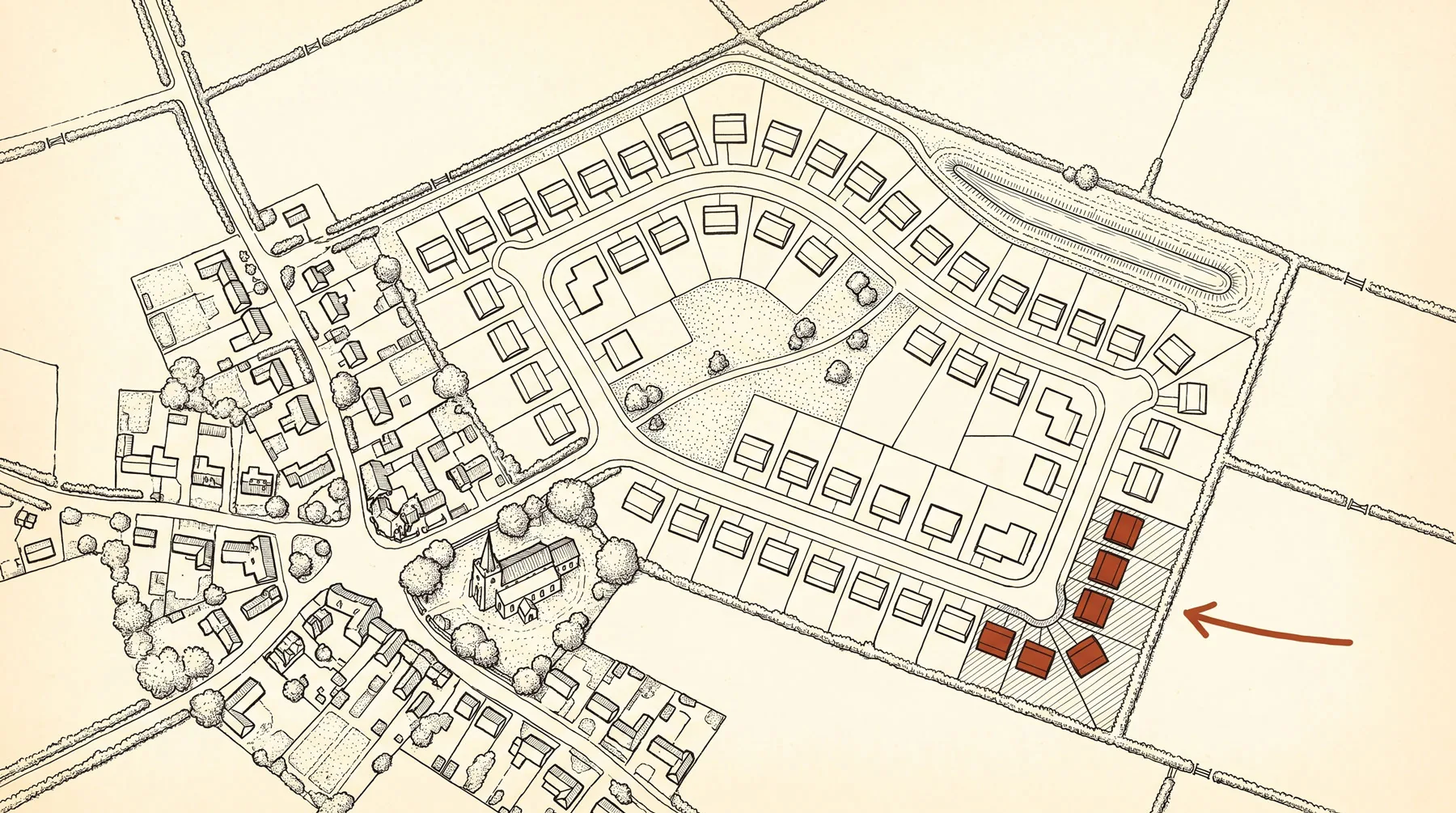
When a council grants planning permission for 150 homes and the planning report says "40% affordable housing secured," people assume that means 60 homes local workers can afford. It does not mean that. The word "affordable" in planning policy has a specific legal definition, and it bears almost no relationship to what most people understand by it.
The definitions.
The NPPF defines four categories of affordable housing. Only one of them is genuinely affordable on typical local earnings.
Social rent is the cheapest. Rents are set by a government formula that takes into account property values, local earnings, and bedroom size. Nationally, the median weekly social rent for a general needs letting in 2024/25 was £106 per week, roughly £460 per month (MHCLG, Social Housing Lettings in England, 2024/25). In practice, social rents run at around 50% of market levels. This is housing that a worker on the minimum wage can afford with the help of housing benefit. It is the tenure that most people picture when they hear the word "affordable." It is also the tenure that gets built least.
Affordable rent is capped at 80% of local market rents. In the Cotswolds, where the average monthly private rent is £1,263 (ONS, February 2026), that means an "affordable" rent of around £1,010 per month. For a two-bedroom house, where private rents average £1,316, the affordable rent would be roughly £1,053. The word "affordable" is doing a lot of work in that sentence.
Shared ownership lets you buy a share of a property, typically 25% to 75%, and pay rent on the rest. You take out a mortgage on your share, pay rent to the housing association on theirs, and pay a service charge on top. The total monthly cost is often comparable to renting privately, sometimes higher, with the added obligations of a mortgage and a lease.
Discounted market sales are homes sold at a minimum 20% discount to market value. In the Cotswolds, where the average first-time buyer price is £319,000, a 20% discount still means a purchase price of £255,000. On a 5% deposit with a 25-year mortgage at current average rates of around 5.5%, the monthly repayment alone would be roughly £1,500.
What this costs a local worker.
The median workplace-based earnings in Cotswold District are £33,872 per year (ONS, 2025). After income tax and national insurance, that leaves a take-home pay of roughly £2,326 per month.
A two-bedroom house at market rent costs £1,316. That is 57% of take-home pay. Nobody considers that affordable.
The same house at "affordable rent," 80% of market, costs £1,053. That is 45% of take-home pay. The generally accepted threshold for housing affordability is spending no more than a third of gross income on housing costs. This "affordable" rent exceeds that threshold by a wide margin.
A shared ownership purchase on a property worth £319,000 at a 25% share would mean a mortgage of roughly £76,000, plus rent on the remaining 75% at a typical 2.75% of the housing association's share, plus a service charge. The total monthly cost comes to around £1,100. That is 47% of take-home pay. And you own a quarter of a house, with a lease that often includes restrictions on subletting, modifications, and resale.
Social rent at around £460 per month would cost 20% of take-home pay. That is genuinely affordable. But social rent makes up a small fraction of what gets built. In 2023/24, just 9,866 social rent homes were completed across England out of roughly 64,000 total affordable completions: around 15% (MHCLG, Affordable Housing Supply in England, 2023/24). The rest was affordable rent, shared ownership, and other intermediate products that remain out of reach for many of the people the policy claims to help.
Get the dispatch.
Long-form, data-first, independent. Housing, planning and infrastructure reporting delivered free to your inbox.
The 40% that isn't 40%.
Cotswold District's adopted Local Plan (Policy H2) seeks affordable housing on sites of 11 or more dwellings, subject to viability, at "up to 40%" of new dwellings and "up to 30%" on brownfield sites. On paper, a greenfield development of 150 homes could deliver 60 affordable units. In practice, several things reduce that number.
First, the 40% is a blended figure across different tenures. The mix is negotiated between the council and the developer. A typical split might be 25% social or affordable rent and 15% shared ownership or other intermediate products. Of the 60 "affordable" homes, perhaps 37 would be for rent and 23 for some form of ownership. Of the 37 for rent, perhaps 15 would be social rent and 22 would be affordable rent at 80% of market. Only those 15 social rent homes are genuinely affordable on the local median wage. That is 10% of the total development, not 40%.
Second, viability. Developers routinely commission viability assessments arguing that the full 40% would make the scheme uneconomic. These assessments are prepared by the developer's own consultants, using assumptions about build costs, sales values, profit margins, and land value that the council often lacks the resources to challenge effectively. The result is a negotiated reduction. Cotswold District Council's own evidence paper acknowledges the tension: social rented housing delivers "a lower return to the developer than other affordable housing tenures" because it is valued at around 50% of market value in viability terms. The incentive is to push the mix away from social rent and towards tenures that cost less to subsidise.
Third, the affordable homes still need a buyer. A housing association has to agree to purchase the affordable units from the developer. In recent years, this market has seized up. A Home Builders Federation survey in October 2024 found around 17,400 Section 106 affordable homes with detailed planning consent across England that did not have a buyer. Housing associations have pulled back from acquisitions because of their own financial pressures: building safety costs, decarbonisation requirements, and rising maintenance bills. Savills reported in July 2024 that 53% of housing associations surveyed had either stopped buying Section 106 homes or reduced their requirements. If the affordable homes cannot be sold to a registered provider, the developer may seek to renegotiate the obligation, convert units to market sale, or delay the scheme entirely.
What changed in December 2024.
The revised NPPF made three changes to affordable housing policy.
It removed the requirement for at least 25% of affordable housing to be First Homes, a discount market sale product introduced by the previous government. First Homes had been widely criticised for not meeting the needs of the people most in need of housing support. Removing the minimum gives councils more flexibility to require social rent instead.
It removed the requirement for at least 10% of all homes on major sites to be for affordable home ownership. Again, this gives councils more freedom to prioritise rented tenures.
It added an explicit expectation that councils should consider the role of social rent when assessing affordable housing needs. The language is supportive rather than prescriptive: councils "should" consider social rent, not "must" deliver it.
These changes point in the right direction. Whether they result in more social rent homes being built depends entirely on whether councils can hold the line in viability negotiations, whether housing associations can afford to buy, and whether developers will accept the lower returns that social rent homes generate. The policy shift is necessary. It is not sufficient.
1,806 households.
There are 1,806 households on the HomeseekerPlus register in Cotswold District (Bromford, October 2025). These are people who have applied for social housing through the allocation system that covers all of Gloucestershire. They are banded by need, they bid on properties when they come up, and they wait.
Bromford, the largest housing association in the district with over 5,000 homes, delivered 350 affordable homes in the Cotswolds over five years, more than half for social rent. There are a further 200 in the pipeline. That is good work, and schemes like the 13 social rent homes at Down Ampney and the 17 at Kempsford show what is possible when a council and a housing association work together on genuinely affordable rural housing.
But 350 homes over five years is 70 per year. Against a waiting list of 1,806 and a new standard method target of 1,036, the arithmetic is plain. The formula generates volume. It does not generate the right homes. The system produces developments of 150 market homes with a contested handful of social rent units negotiated down from an already inadequate quota, while the people on the waiting list keep waiting.
There is a further dimension to this that the definitions do not capture. The largest builder of newly built affordable homes in England is not a housing association. It is Sage Homes, a subsidiary of Blackstone, the American private equity firm, with a portfolio of 20,000 UK homes and £3.7 billion committed. Last year Blackstone sold 3,000 shared ownership homes to a pension fund for £405 million. Affordable rent at 80% of market generates a reliable, inflation-linked yield backed by housing benefit. Social rent generates less return but the scale is attractive. Institutional capital is not replacing housing associations, but it is increasingly sitting alongside them, and the incentives are different. A housing association exists to house people. An investment fund exists to generate returns. Both now operate within the same planning definition of "affordable." The system does not distinguish between them.
Connection to the standard method.
The standard method uses the affordability ratio to inflate housing targets. But the homes that result from those targets are overwhelmingly market homes, priced for the same buyers who made the area expensive in the first place. The affordable housing secured through Section 106 is a minority of the total, is frequently negotiated downwards, and in its dominant tenures, affordable rent and shared ownership, remains beyond the reach of workers on local earnings.
The formula says: houses are unaffordable here, so build more. What gets built does not make houses affordable. The affordability ratio does not improve. The formula generates the same target next year.— The Editor · Ground Level, May 2026
The formula says: houses are unaffordable here, so build more. What gets built does not make houses affordable. The affordability ratio does not improve. The formula generates the same target next year. The people who needed a home they could afford are in exactly the same position, except now there is an estate on the edge of their town that was not there before.
The problem is not the number of homes. It is the type. Until the system is redesigned to deliver social rent at scale, rather than market housing with a contested affordable quota bolted on, the word "affordable" in planning policy will continue to mean something that no local worker would recognise.