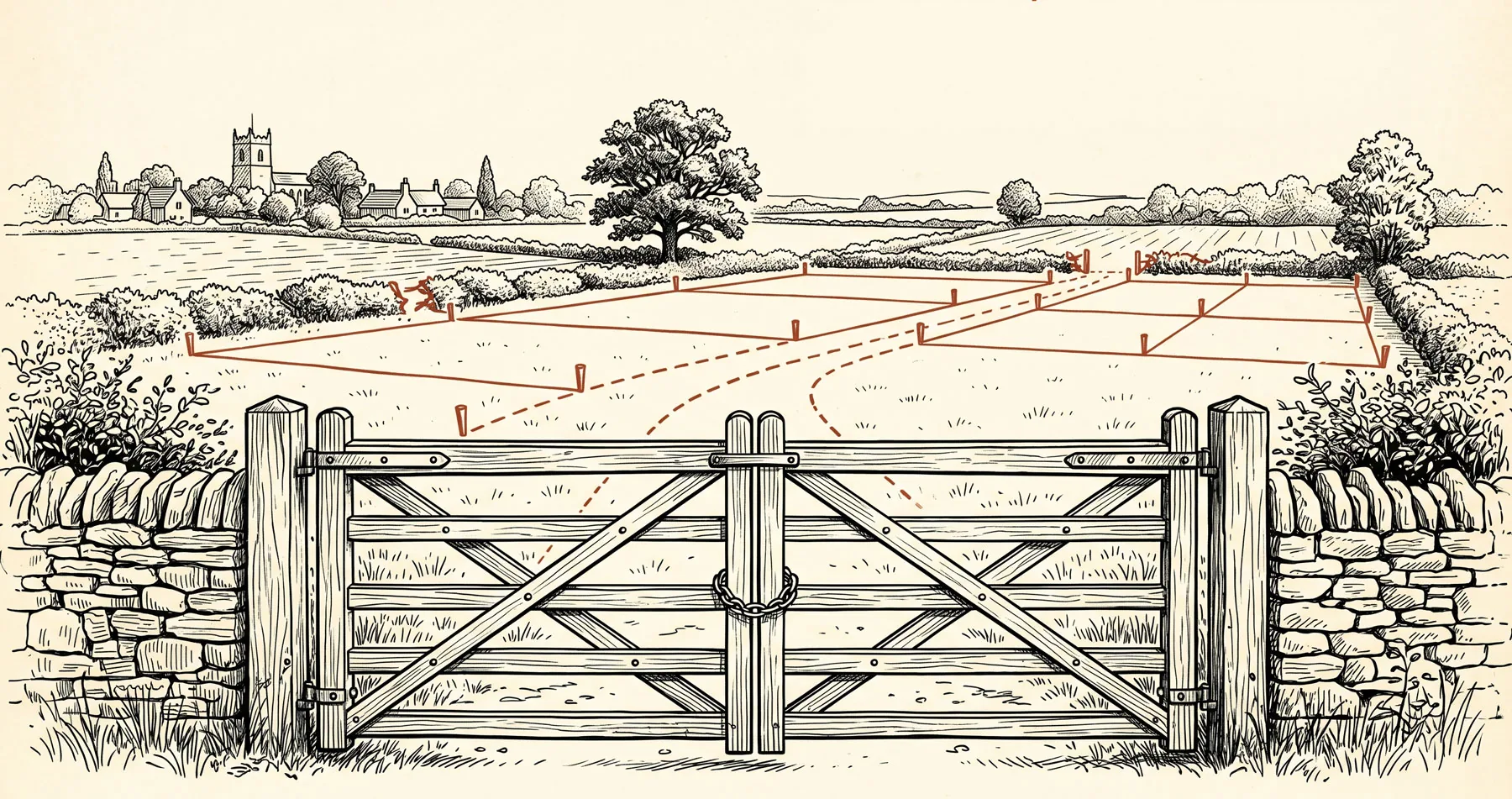
A farmer in Gloucestershire owns a field. It has been in the family for generations. One day, the council grants planning permission for housing on that field, and it becomes worth tens of times what it was worth the day before. The farmer did not build anything. The council did not build anything. A decision was made, and value was created. What happens next, who captures that value, how the price is set, and why the farmer often receives less than they were promised, is the subject of this article. It is the piece of the system that sits underneath every other explainer.
The uplift.
The scale of the value created by a residential planning permission is enormous, but it varies widely by location.
Agricultural land in England averages about £8,000 to £10,000 per acre for arable farmland, according to Savills and Strutt & Parker's 2024-25 market reports. Best-in-class sales have reached £13,500 to £17,000 per acre. These are serious sums for a farming family. The government's land value estimates for policy appraisal (DCLG, February 2015) use a figure of roughly £8,500 per acre (£21,000 per hectare) as the agricultural baseline for England.
With residential planning permission, those values transform. The same estimates put the average for residential land in England outside London at approximately £790,000 per acre (£1.96 million per hectare). But that average conceals a range that runs from a few hundred thousand per acre in parts of the North and Midlands to several million in the south east and tens of millions in London. A greenfield site on the edge of a town in County Durham with permission for housing might be worth £150,000 to £250,000 per acre. The same field on the edge of a town in Berkshire might be worth £1 million or more. The agricultural starting point is broadly similar in both places. The residential end point is not. The government's estimates are free, published on GOV.UK, and broken down by local authority area. Any reader can look up the residential land value for their own district.
The gap between agricultural value and residential value is where the economics of English housing plays out. It is where councils try to extract affordable housing and infrastructure contributions through Section 106 and CIL. It is where developers, promoters, and landowners compete for their share. And it is where successive governments have tried, and mostly failed, to redirect more of the windfall.
The residual valuation.
The method by which most development land in England is priced is called the residual valuation. The formula is simple. Start with the projected sales value of the finished homes (the Gross Development Value). Deduct construction costs, professional fees, finance charges, contingencies, Section 106 and CIL obligations, biodiversity net gain costs, and the developer's profit. Whatever is left is what the developer can pay for the land.
The critical feature of this formula is which inputs are treated as fixed and which are treated as flexible. Build costs are anchored to industry benchmarks. Sales values are set by local comparables. Finance costs are determined by lending rates. Developer profit is also treated as fixed: Planning Practice Guidance has since 2018 codified a return of 15 to 20% of Gross Development Value as the benchmark for a deliverable scheme. No major lender will fund a project offering less than about 15%. The RICS professional standard on financial viability requires practitioners to apply these PPG inputs. The result is mechanical. Land is the residual. It is the only number that flexes.
This is unusual. In most industries, the producer buys raw materials at a market price, adds labour and overheads, applies a margin, and sets the selling price. If costs rise, the margin compresses or the price goes up. In English housebuilding, the logic runs backwards. The selling price is set by the market. The margin is set by government guidance. The costs are set by the supply chain. And whatever is left over is what the landowner gets for the land. The developer's profit is protected. The landowner's return is the residual.
The December 2025 draft NPPF, consulted on until March 2026, opens the first serious discussion in years about compressing the numbers. The consultation asked whether single figures for developer profit would bring certainty, and gave 17.5% of GDV for most market housing as an example (question 202). It asked whether 6% would suit affordable housing tenures, which carry less risk because plots are pre-sold to registered providers (question 203). It asked whether councils should test viability at the plan-making stage against a standardised benchmark land value scenario of 10 times Existing Use Value for greenfield Green Belt land (question 143), a multiple that echoes the Letwin Review. And draft policy DM5 said the price a developer actually paid for the land, including the price embedded in an option agreement, could not be used to justify failing to meet policy requirements.
There is a problem with the 10x EUV scenario that the consultation does not fully confront. Agricultural land values are broadly similar across England. Arable farmland runs £8,000 to £10,000 per acre whether the field is in Wiltshire or Northumberland. Ten times that gives you roughly £80,000 to £100,000 per acre regardless of location. But the end product value varies enormously. A new-build four-bed detached along the M4 corridor around Swindon or Reading sells for £430,000 to £600,000 depending on location and specification. The same house in parts of County Durham or Northumberland might sell for £200,000 to £280,000. Under the residual method, the M4 corridor site might support a land value of £400,000 or more per acre. The northern site might support £80,000 to £120,000. The 10x scenario is roughly right in lower-value areas and massively below market in higher-value areas. A plan whose policy requirements were tested on it would assume that land in the south and east, where housing is most needed, sells at a fraction of what the residual would give. Landowners there have no rational incentive to sell at that price. They will hold out. And if the whole system depends on the end product value to set everything else, you cannot pretend location does not matter when it comes to setting the land benchmark. The consultation floats a flat multiplier on a roughly uniform input to test an output that varies by a factor of five across the country.
If taken forward, these proposals would mark the first time in a generation that the government has intervened directly in the arithmetic that determines what landowners receive. Whether a 10x scenario survives contact with the land market in high-demand areas is an open question.
Get the dispatch.
Long-form, data-first, independent. Housing, planning and infrastructure reporting delivered free to your inbox.
How land comes forward.
Very little development land in England is sold through a simple transaction. The dominant instruments are option agreements, promotion agreements, and conditional contracts, each with its own mechanics and distribution of risk.
An option agreement gives a developer the right, but not the obligation, to buy land at a pre-agreed price or formula once planning permission is obtained. Typical durations are 5 to 10 years, extending to 15 or 20 on major strategic land. The purchase price is usually set at open market value less a discount of 10 to 15%, sometimes 20 to 25%, to compensate the developer for bearing planning risk. Once signed, the developer controls the planning process: choosing the consultants, designing the scheme, deciding what qualifies as a satisfactory permission.
The dynamic that matters is this. At the point the option is exercised, the developer and the landowner have directly opposing interests. Every cost the developer can load into the appraisal, and every assumption that pushes the valuation down, reduces the price paid to the landowner. The valuation is negotiated, not competitively bid. Disputes go to an RICS-appointed surveyor. The landowner may have been shown a headline figure per acre at the start. By the time the costs are deducted, the discount applied, and the viability assessment completed, the actual payment can be substantially less.
A promotion agreement works differently. The promoter does not buy the land. It funds and manages the planning application, then sells the consented site on the open market through competitive bids. The promoter takes 15 to 20% of the net proceeds. Because both parties earn more when the sale price is higher, their interests are aligned. Prominent promoters include Catesby Estates (owned by the Wellcome Trust through Urban and Civic), Richborough, and IM Land. The promotion model emerged from the 2008 financial crash, when volume housebuilders retreated from speculative strategic land acquisition and a generation of redundant land professionals set up independent firms. A Henley Business School study found that volume housebuilders themselves secured only around 35% of residential units granted outline consent in the study year. The rest came through promoters, smaller developers, and other routes.
Conditional contracts sit between the two: a binding sale triggered by planning, with a fixed price and a long-stop date. Hybrid agreements layer options with overage clauses or promotion backstops to manage the tension. In every case, the pattern is the same. A farming family that may have held land for generations enters a legal agreement with a professional organisation whose entire business is structuring these transactions. The information asymmetry is significant. The landowner is making a once-in-a-lifetime decision. The developer or promoter does this every week.
Land banking.
The major housebuilders hold very large land banks. The CMA's 2024 housebuilding market study found aggregate land banks across 11 firms of over a million plots: roughly 658,000 in long-term strategic pipeline and 522,000 in short-term implementable supply. Barratt Redrow alone holds about 100,000 current plots and 145,000 strategic. Taylor Wimpey holds around 79,000 current and 136,000 strategic. Persimmon holds roughly 82,000 current and 77,000 strategic.
The accusation is simple: builders are sitting on permissions to restrict supply and keep prices high. The evidence does not support it. Every major independent review of the question, from Kate Barker in 2004 through Callcutt in 2007 to the OFT in 2008 to Letwin in 2018 to the CMA itself in 2024, has reached the same conclusion. Builders are not hoarding implementable consents for speculative gain. They are hedging against a planning system that can take years to deliver a permission, that loses applications in overloaded departments, that imposes contradictory requirements from different consultees, and that can withdraw a consent at judicial review. The planning process itself is a major driver of the land bank: builders acquire far more pipeline than they immediately need because they cannot predict which sites will make it through and when.
What Letwin found on the 15 large sites he examined was that the binding constraint on build-out speed is the market absorption rate. Builders cannot sell faster than the local market can absorb without depressing prices. Since they paid for the land on the basis of those prices (through the residual valuation), selling below them would destroy the economics of the deal. His recommendation was not to punish land banks but to diversify tenure and type on large sites so that multiple sub-markets could be served in parallel: market sale, affordable rent, social rent, build-to-rent, self-build. The government accepted the diagnosis but declined the legislative package.
The CMA did flag 29 local areas where concentrated land ownership by a single builder raised competition concerns. And the speculative private-housebuilding model remains structurally incompatible with a sudden acceleration to 300,000 homes a year. Land banking is not the cause of slow build-out. It is a symptom of the residual model and the planning system that feeds it.
The inheritance tax changes and farmland.
The other policy shock to hit English land in this period came from the Treasury, not from planning. On 30 October 2024, Chancellor Rachel Reeves announced the biggest reform to Agricultural Property Relief in more than thirty years.
Before the Budget, qualifying agricultural land attracted 100% relief from inheritance tax with no cap. The relief had existed in roughly this form since 1992 and was originally designed to prevent farming families from having to sell land to pay death duties. Over time it became concentrated: HMRC data showed the top 7% of APR claims (about 117 estates) took 40% of the relief, and the wealthiest 2% averaged £6 million each. Tax advisers routinely recommended agricultural land as an inheritance tax shelter for clients with no connection to farming.
Reeves announced a combined cap of £1 million per individual on 100% APR and Business Property Relief from April 2026. Value above the cap would attract only 50% relief, producing an effective inheritance tax rate of 20% on the excess. The farming community erupted. Around 13,000 people gathered in Parliament Square in November 2024. Tractor go-slows disrupted roads across the country. The NFU estimated that 70,000 farms could be affected over a generation.
The numbers were contested on both sides. The government said only about 500 estates per year would pay more tax. The NFU said 2,000 to 2,500 per year. CenTax, an independent tax research centre at Warwick and LSE, estimated 480 to 600 and found that 86% could pay from non-farm assets. Around 40 estates per year would face instalment obligations exceeding 20% of farm income. The 70,000 figure described a generational total of farms that might at some point exceed the threshold, not annual casualties.
After sustained pressure, the government retreated. In the Autumn Budget of November 2025 it made the allowance transferable between spouses. In December 2025 it raised the cap from £1 million to £2.5 million per person, meaning a married couple can now shelter roughly £5.65 million including nil-rate bands. The reform still takes effect in April 2026, but in a substantially softened form.
The practical reality for farming families is harsh regardless of the government's stated intentions. Average cereal farm profit runs to roughly £34,000 a year (NFU). Many farms are barely breaking even. When the owner dies and the inheritance tax bill arrives, the children face a choice: take on a business that generates less income than the annual instalment payment, or sell. In a market where land promoters and housebuilders are actively seeking sites, the buyer is rarely another farmer. The government says the policy is about revenue and fairness. The Treasury says it is targeting investors who used APR as a tax shelter rather than working farmers. Both of those things may be true. But APR reform, the hope-value changes in the Planning and Infrastructure Act, the New Towns programme, and the NPPF viability proposals all push in the same direction: weaker landowner bargaining power and more land coming to market under pressure rather than by choice. Whether that convergence is deliberate or coincidental, it is real. And for a family that has farmed the same land for generations, the distinction between policy intent and practical effect is academic.
Capturing the uplift.
If the planning permission creates a windfall, how much of it does the public capture? Estimates vary. The Centre for Progressive Policy put it at roughly 27% through S106 and CIL. Savills, including related taxation and enabling works, put it nearer 50%. Either way, England captures substantially less than comparable European systems. The Netherlands, through active municipal land banking, captures an estimated 80 to 90%. Germany, through land readjustment and municipal pre-emption, captures 60 to 70%. Singapore captures close to 100% through state ownership.
England has tried three times to close the gap. The 1947 Town and Country Planning Act imposed a 100% development charge on planning uplift and allowed New Town development corporations to acquire land at existing-use value. The charge was abolished in 1953. The 1967 Land Commission Act imposed a 40% betterment levy, intended to rise to 50%. The incoming Conservative government scrapped it within five weeks of taking office in 1970. A third attempt in 1975 was abolished by 1985. Each was criticised for complexity and for allegedly reducing land supply, though the evidence on the latter was always disputed.
The Levelling-up and Regeneration Act 2023 made a cautious, targeted fourth attempt, and the Planning and Infrastructure Act 2025 extended it. The 2023 Act inserted section 14A into the Land Compensation Act 1961, which allows a compulsory purchase order to direct that hope value be disregarded where the scheme includes affordable housing, education, or health. Section 113 of the 2025 Act extended the power to land bought on behalf of parish councils and carried it through to home loss and basic loss payments. Hope value is the slice of open-market value that reflects the prospect of future planning permission. Before the reform, a council buying a field for a school or affordable homes had to pay a premium for that prospect, often the difference between £10,000 and £500,000 per acre. The disregard brings the compensation back towards existing-use value for qualifying schemes. Seven new town locations have been proposed, led by Tempsford in Bedfordshire, Crews Hill in Enfield, and Leeds South Bank, with a target of 40% affordable housing and half of that at social rent.
Whether this amounts to a structural shift or another gesture that will be reversed by the next government is the open question. The three previous attempts lasted 6, 3, and 10 years respectively.
When construction costs go up, the land price goes down. When planning obligations are loaded on, the land price goes down. When the viability assessment is submitted to the council, the affordable housing goes down. The developer's margin does not move.— The Editor · Ground Level, June 2026
The number underneath everything else.
The residual valuation method is the mechanism that connects every other explainer article. The standard method sets the housing target. The five-year supply test forces councils to grant permissions. The Local Plan allocates the sites. Section 106 and CIL extract contributions from the development value. Viability assessments fight over how much of the residual goes to affordable housing versus the landowner. Infrastructure is funded from the same pot. And the land price absorbs every pressure in the system because it is the only number nobody has fixed.
The residual valuation is a developer-led model. The developer sets the sales assumptions, the cost assumptions, and the profit margin. The developer controls the planning application under an option agreement. The developer commissions the viability assessment. The landowner is presented with a number at the end of a process they did not control, built on assumptions they did not set, using a method that protects the developer's return while treating the land price as the thing that gives. When construction costs go up, the land price goes down. When planning obligations are loaded on, the land price goes down. When the viability assessment is submitted to the council, the affordable housing goes down. The developer's margin does not move.
The landowner entered the deal on the basis of a figure that looked good on paper. By the time the option is exercised, that figure has been through a process designed to compress it. Once the land is sold, it is gone. A field that was in the family for generations is now a housing estate. The farmer received what the residual gave them.